
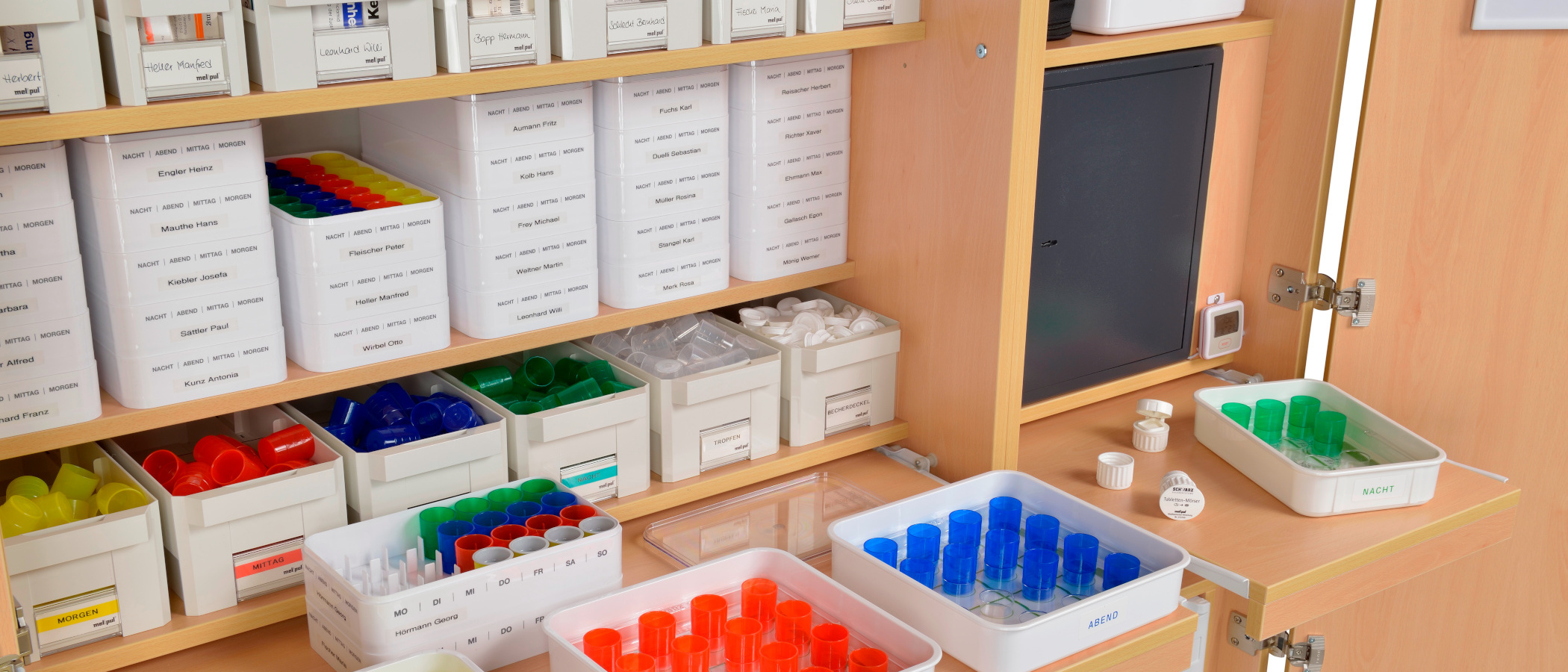
In accordance with the German Care Homes Act (HeimG) § 11 (BGB), special requirements apply to the storage of medicines in nursing homes. Care home operators must ensure that all medicines are stored properly and assigned to individual residents. Medicine cabinets play an important role in this task.
The medicine cabinet is an indispensable part of every nursing home and is used to store the residents’ medication. It helps nursing staff to keep all the medication needed each day safely stored. In our online shop you will find medicine cabinets for every type of care facility. We offer a wide selection of cabinets in different sizes and with various features to meet your care needs.
The melipul medicine cabinet is available in a large and a small version. Both versions have doors that can be locked with an espagnolette lock, making them particularly secure.
Conveniently, the cabinets feature a pull-out worktop that can be used to prepare and organise the medication according to the respective schedule. They are also equipped with adjustable shelves that provide space for cabinet containers and medication storage as required.
In addition to stock and as-needed medication, the medicine cabinet also holds the dispensing trays on which the daily medication is prepared for mealtimes. Cabinet containers, pull-out wire baskets and a permanently fixed controlled drugs compartment complete the range and accommodate all other care supplies. The medicine cabinet even has a built-in refrigerator with an integrated vent for the heat it generates.
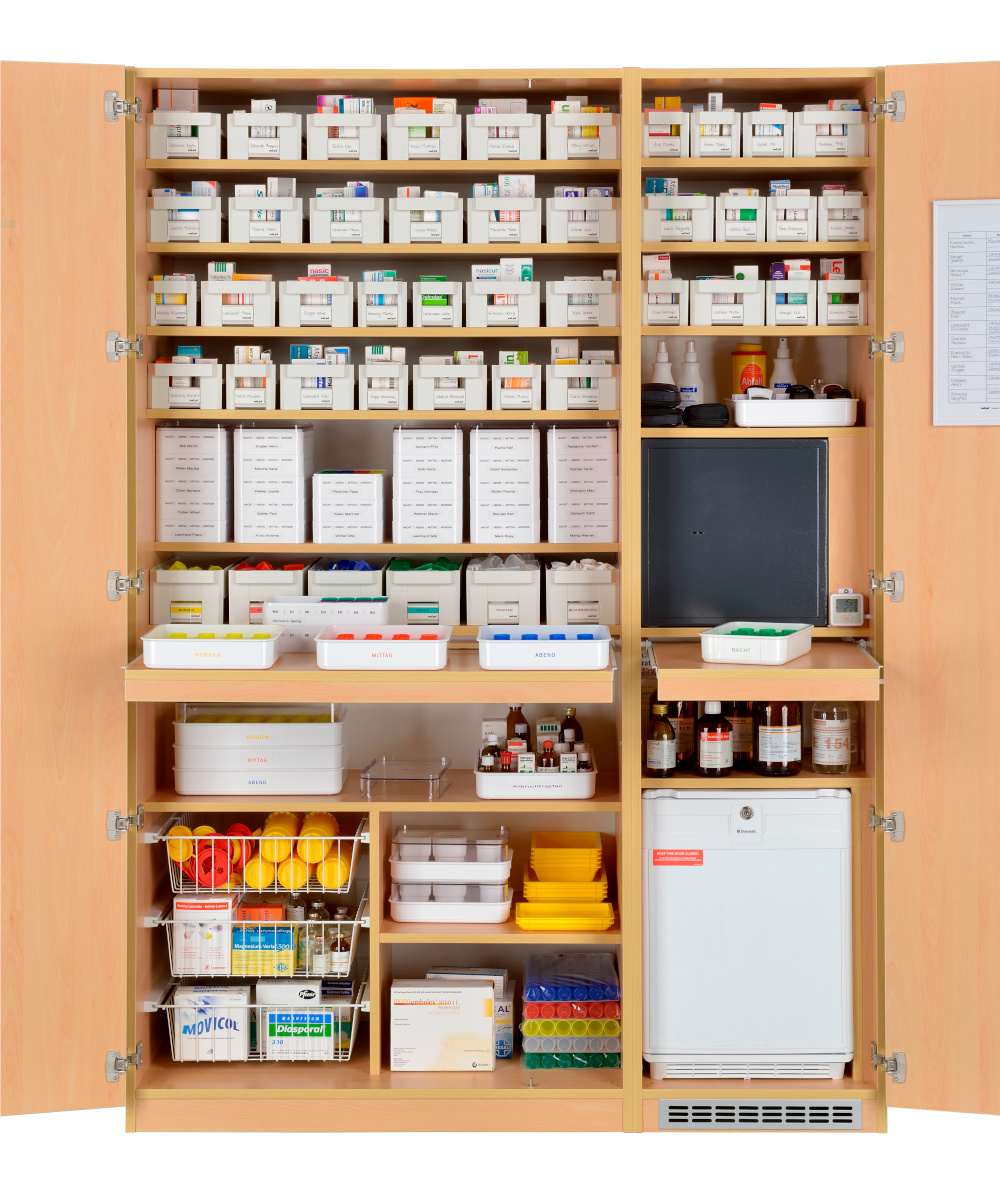
Large medicine cabinet with pull-out worktop, lockable doors, controlled drugs compartment, medication refrigerator and adjustable shelves to the product
While the large version of the melipul medicine cabinet holds the medication for up to 30 residents, the small version accommodates up to 20 residents. Storing tablets prepared on a weekly basis is particularly easy in dispensers such as the melipul weekly dispenser 7x4.
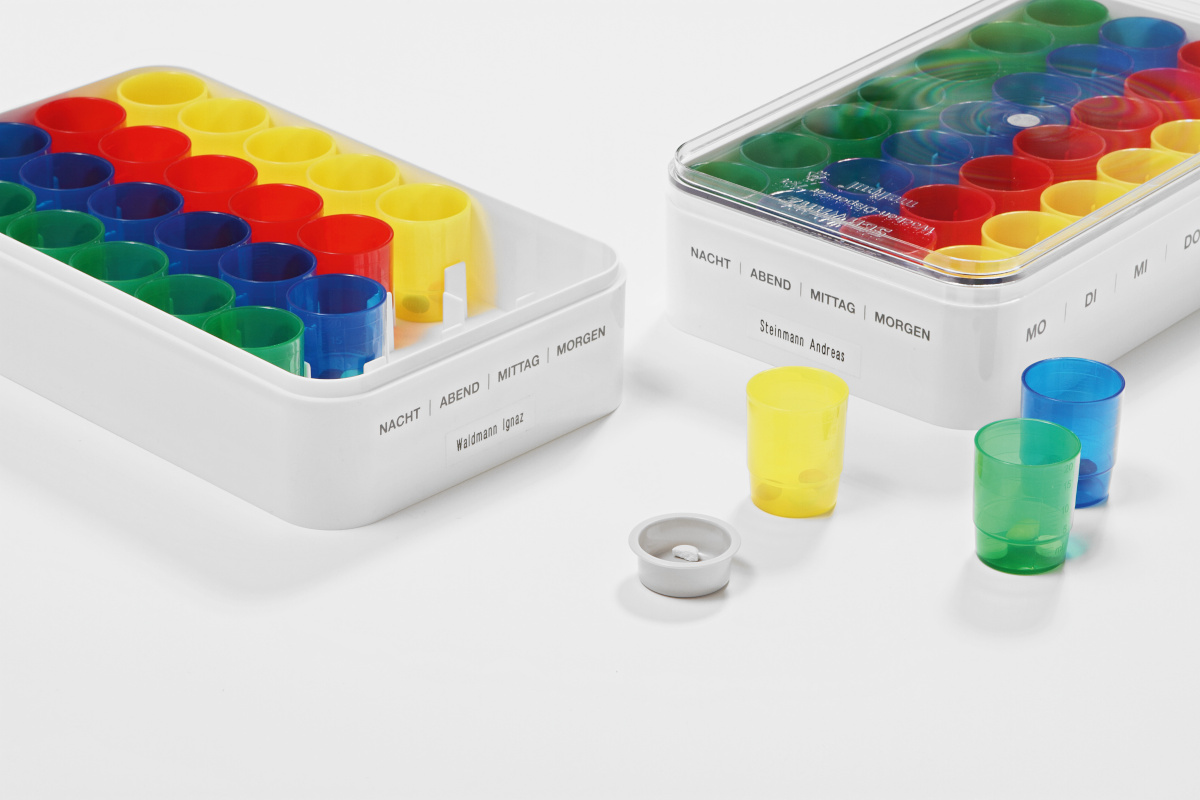
Medication dispenser with cups for seven days to the product
For the weekly preparation of medication, the melipul medication dosers XL with several compartments are also a good choice. The melipul medication doser XL-5, for example, has five compartments and is therefore a clearly organised aid.
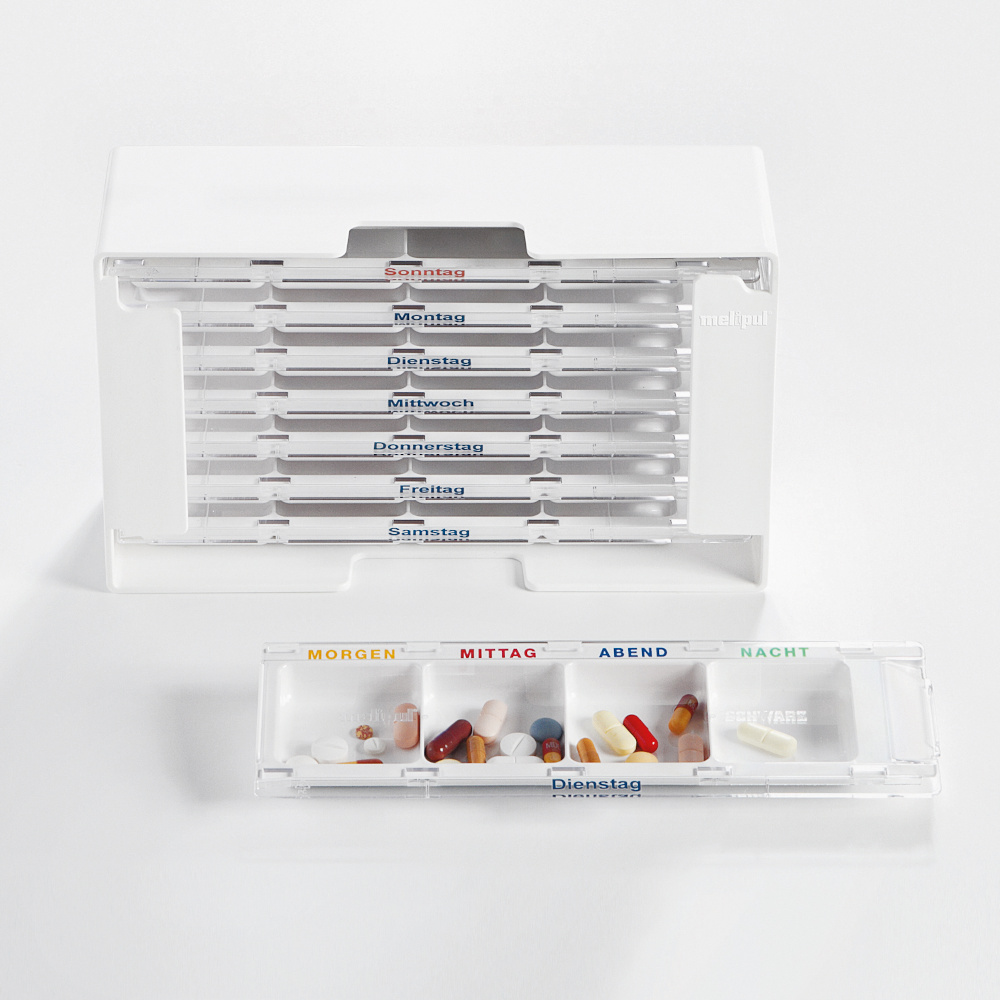
Medication dispenser with five compartments to the product
As a rule, the medicine cabinet is located in the ward office or staff room of the respective ward. Alternatively, it can be placed at a central medication point so that the ward is optimally supplied with medication at all times. When the weekly delivery of medication arrives from the pharmacy, it is stored in the medicine cabinet.
Every day, the nursing staff prepare the medication for administration to the residents, using various dispensing trays from the melipul system. Popular choices include cup trays for the complete daily medication, which hold 12 to 44 cups for tablets and drops or, in the case of trays with variable compartments (VF), also offer space for powder sachets. The labelable trays make distributing medication in the nursing home clear and straightforward.
A medicine cabinet is a store for keeping medicines and medication assigned to individual residents in care facilities. To keep storage well organised, medicine cabinets usually contain various dispensing trays and cabinet containers, such as those of the melipul system.
Many modern medicine cabinets have an integrated medication refrigerator. This is where all medication that must be stored at a temperature of two to eight degrees Celsius belongs. Besides insulin, this includes some asthma inhalers and antibiotic suspensions, vaccines, certain (glaucoma) eye drops and eye ointments, as well as other biologics used, for example, to treat rheumatism.
The medicine cabinet also has a controlled drugs compartment for storing medicines that fall under the German Narcotics Act (BtMG) and must be prescribed on a special narcotics prescription. These include therapeutically used substances such as fentanyl, buprenorphine, dronabinol, methadone, methylphenidate, opium, morphine, pentazocine and tilidine.

 Deutsch
 français
 italiano